
I think generally we lack mental models of dynamic systems. The debate around national debt often falls back on inappropriately applied heuristics; a government unlike a household is infinitely lived, it should be minimizing the long run tax burden and faces a borrowing constraint that is not time bound. Here I present a simple model for thinking about the national debt, it helps reason about two questions:
Can a government run a persistent budget deficit?
Can national debt grow forever without bankrupting the nation?
Let us define some variables:
D(t) is the debt at time t, with the initial debt being zero: D(0)=0
y(t) is the national income at time t, initial income restricted to one: y(0)=1
r is the interest rate on debt
rD(t) is the total interest payment at time t
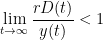
Default condition is:

Sustainability implies:
The time path of debt is D = by(t), b > 0 where b = Budget Deficit / National Income
Income increases at the growth rate g:

We need to find the time path and steady state of:

We can start with the income growth rate:
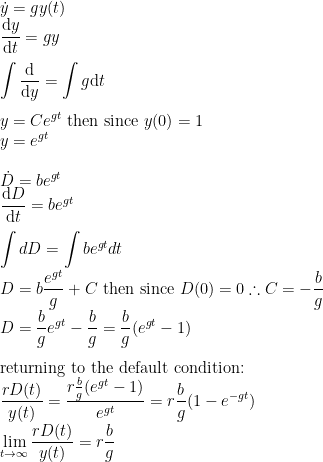
As long as r is low enough and g is large enough then a government can run budget deficits indefinitely. Some anti-debt arguments rely on large changes to r or g, but do either of these ever change quickly? What is probably more worrying is the default condition, this is a autarky model – for me this means the most worrying thing is the financial contagion that changes the default condition in a way that we will not see coming.
 DeepForest.io